Portfolio — eight documented systems

Case studies

Multi-agent systems I have built, deployed, or am actively shipping — plus two worked examples of how a Portuguese permitting engagement runs. The architecture transfers; the connectors and prompts change per client.

Realbuilt, delivered, or in production Teamgroup work, credited Illustrativefictional client, real workflow — clearly disclaimed
Part one — built and real

Systems that exist

Everything in this section has run — on my own data, on a real building, or inside a supervised master’s programme. No mockups.

I
In production

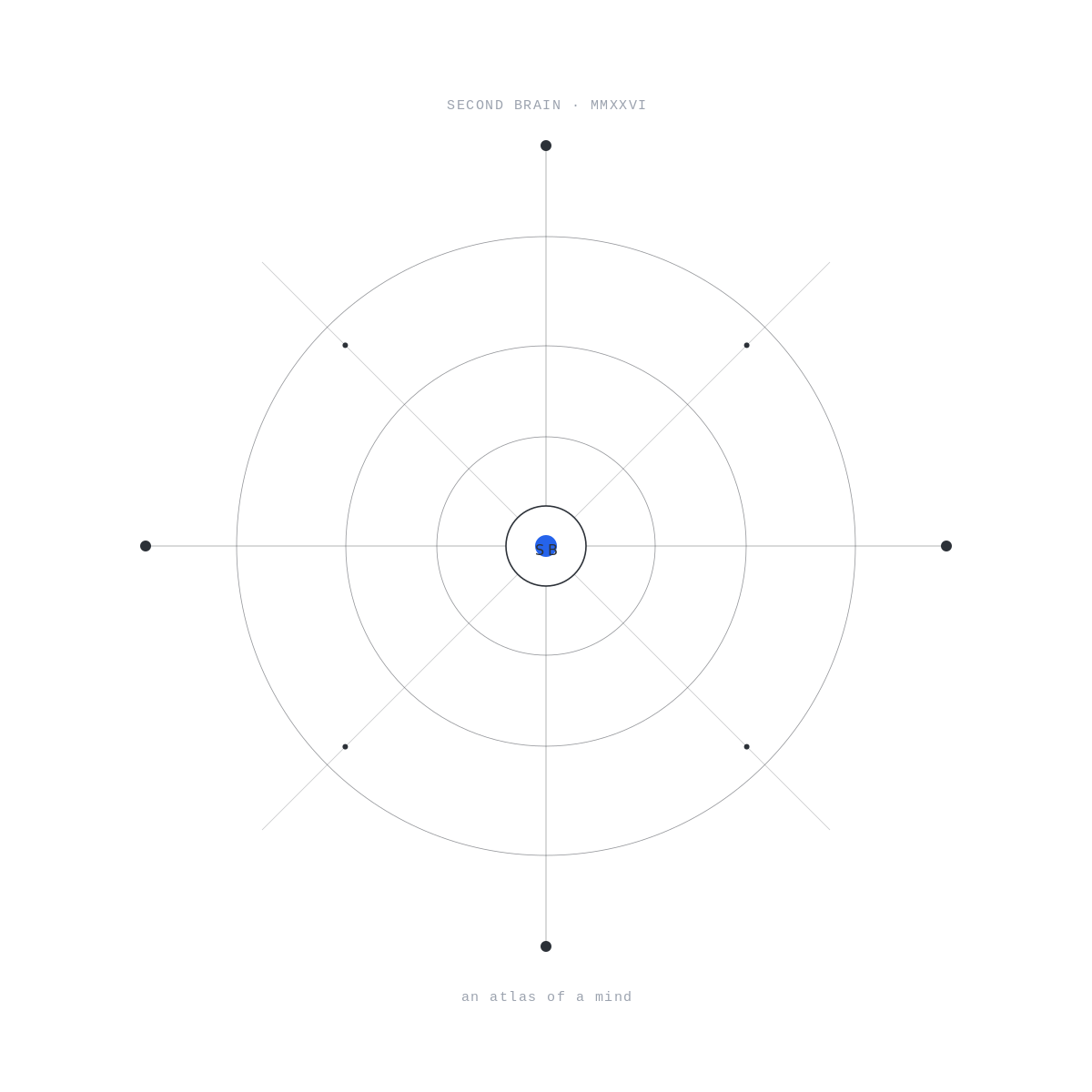
Project Memory System

The deployed prototype of the methodology behind every Project Brain Build. Solo work, in daily production since 2025.

Python · Claude · Obsidian · SQLite FTS5 · cron — solo

The problem

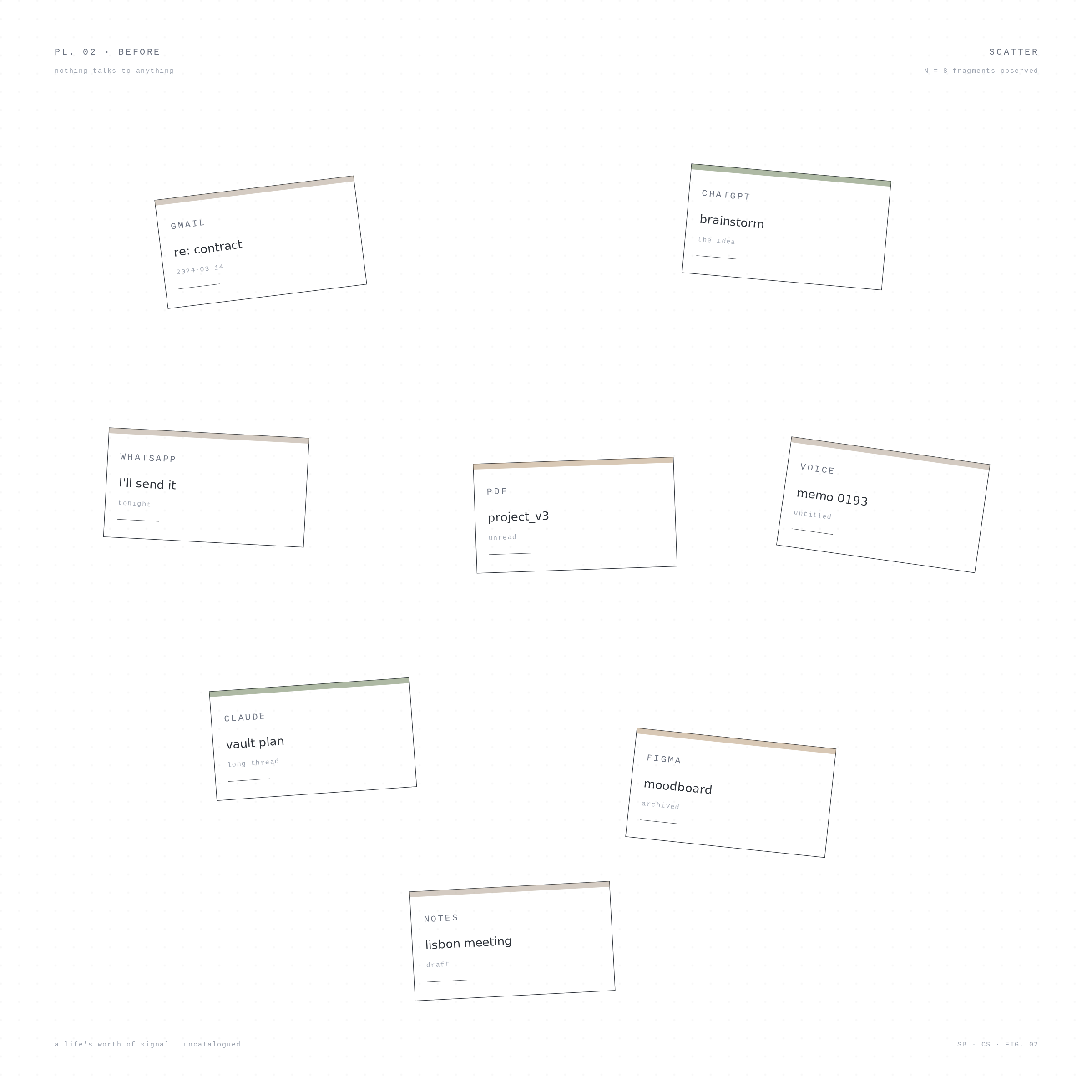
AEC firms accumulate a decade of context — emails, drawings, contracts, meeting notes, regulatory documents — that no one can retrieve when it matters. By the time a partner needs “what did we agree with client X about Y last March?”, it’s faster to forget the question than find the answer. Before building project-memory systems for firms, I built and operate one on my own life.

What I built

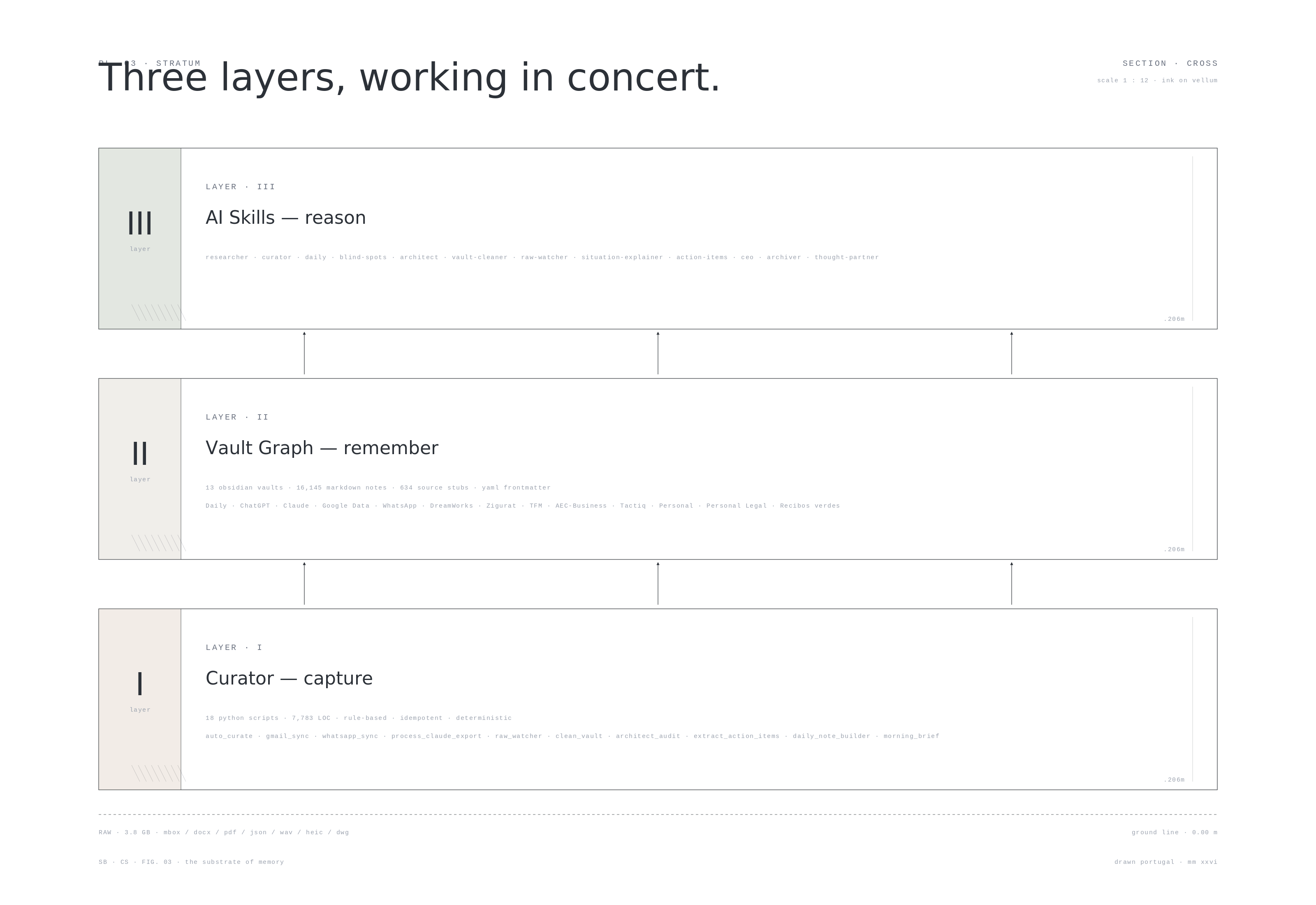
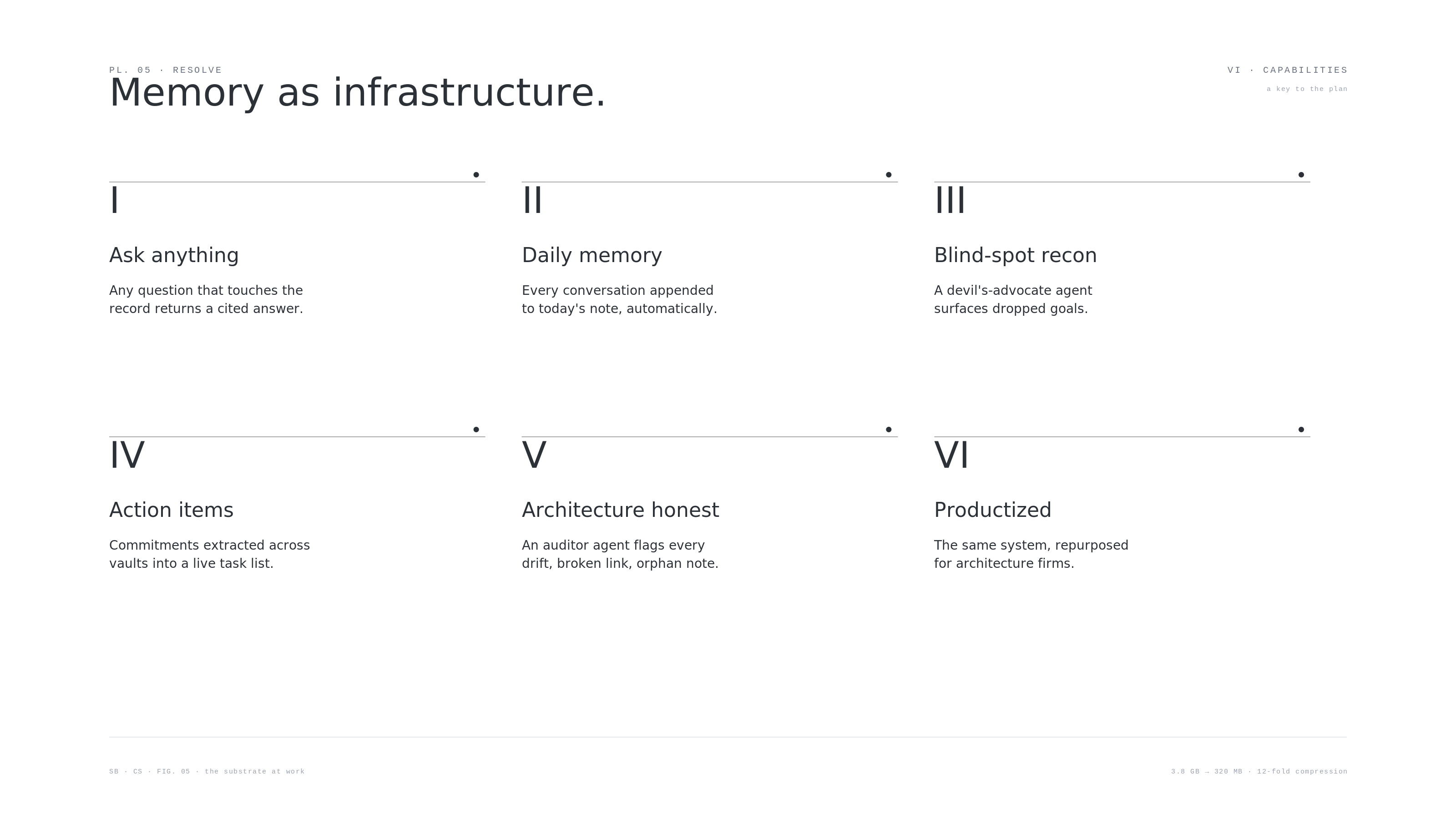
  • Ingestion: Gmail every 4 h, Calendar daily, WhatsApp full-history, ChatGPT/Claude exports, meeting transcripts, a local-file watcher — all custom Python, all on cron, all idempotent, all locally stored.
  • Curation: 11 categorized vaults, ~305 MB curated context, source stubs tracing every note to its original file, append-only decision log, SQLite FTS5 retrieval index, quarantine folders — nothing deleted, only moved.
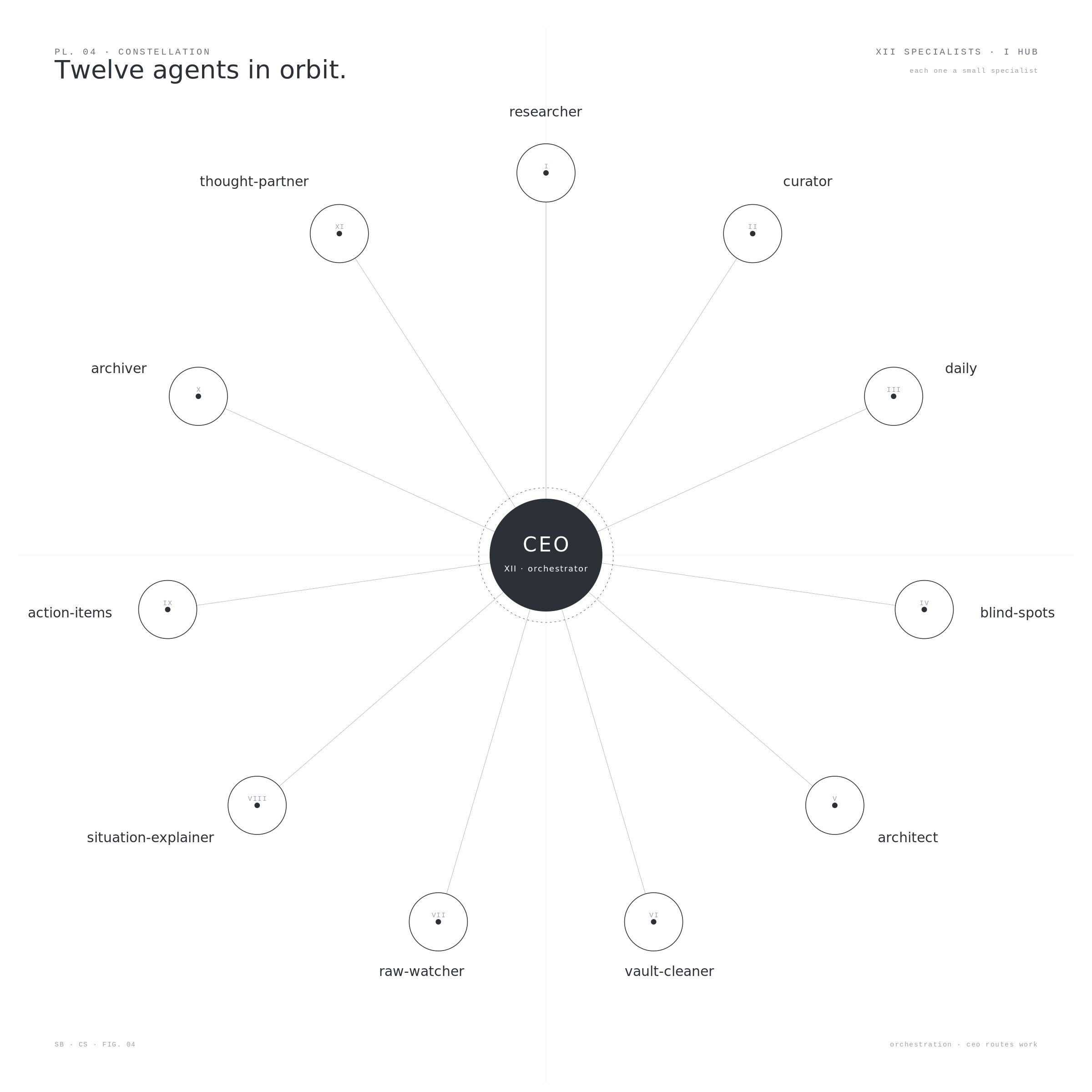
  • Multi-agent layer: 12 specialized AI skills — curator, researcher, daily, blind-spots, architect, vault-cleaner, orchestrator and more.
  • Automation: morning brief 7 a.m., daily note 10 p.m., weekly review Sunday.
  • Governance: local-first, zero-data-retention DPA, aligned with EU AI Act art. 4 + art. 50.

7,571 lines of Python · 17 production scripts · 12 AI skills · 11 vaults. Last architecture audit examined 8,775 notes and produced a prioritized fix-it queue.

Why it matters for your project

The transfer is mechanical: email → project-management tool, chat → team channel, files → BIM/document archive. The runtime risk is low because the system already runs in production daily — the work is connector substitution and prompt re-targeting, measured in weeks, not months.
II
Ran end-to-end on a real residence

Green Score — Embodied Carbon from BIM

A 2-agent CrewAI system that turns an IFC model and project documents into a defensible embodied-carbon report in minutes. Solo R&D.

CrewAI · Claude Sonnet · IfcOpenShell · ICE Database v3 — solo

The problem

Teams need the carbon footprint of a design before construction — but the numbers live in three disconnected places: the BIM model, the spec book, and the quantity takeoff. Reconciling them by hand is a junior-engineer week, so most projects skip it.

What I built

Agent 1 — BIM Quantity Analyst reads the IFC, extracts net volumes per element, cross-references the memorial descritivo. Agent 2 — Embodied Carbon Specialist applies ICE v3 coefficients, computes total kg CO₂e and a Green Score, identifies hotspots, and writes a DOCX report with costed mitigation actions. Sequential crew — the reasoning chain stays auditable.

Outcome — real 186 m² residence, Recife

  • Green Score 42/100 · total embodied carbon 102,410 kg CO₂e (549 kg/m²)
  • Hotspots: rebar steel 39.9% · ceramic masonry 17.6% · concrete structure 14.5%
  • Five mitigation actions, each with projected impact, cost, and ROI

Combined effect: −17.7% embodied carbon, score 42 → 58, for ~2.2% of project cost. Every number traces to a model volume and a published coefficient.

III
Delivered 2026 · private commission

Bret & Rachel — A Residential BIM Rebuild

A two-dimensional drawing set rebuilt as a full Revit BIM model and visualised in photoreal renders.

AutoCAD DWG → Autodesk Revit → photoreal rendering — solo

The problem

The clients had a complete 2D CAD set — adequate for permits, illegible to a non-technical eye. A DWG describes geometry; it doesn’t describe volume, light, or how the porch reads from the street at four in the afternoon. They needed to see the house before it was built.

What I built

A complete, fully parametric Revit model — layered walls, composite roof, families, porch, detached garage, site from aerial imagery — plus a set of photoreal daylight exterior renders. A change in the brief propagates through every plan, elevation, and render automatically.

Why it matters

A drawing set is a contract. A BIM model is a conversation. Material swaps cost minutes in Revit and zero on site; proportion problems get caught on screen, not after framing. For renovation or visualisation work on legacy-CAD properties, the same pipeline transfers directly.

IV
Team master’s thesis · defense Aug 2026

Multi-Agent BIM Acoustic Coordination

A 7-agent system verifying acoustic compliance on BIM models against Portuguese regulation (RRAE / DL 96/2008). Zigurat Institute, in active development.

IFC · BCF · ifcopenshell · RAG · JSONL decision memory — team of five

The problem

Acoustic compliance data lives in three disconnected places — the IFC model, the acoustic report PDF, and the memorial descritivo. Coordination today is manual cross-reference at the end of design, when changes are expensive. No openBIM-native tool closes the loop.

What we’re building

Seven agents — orchestrator, IFC reader, report parser, deterministic verifier, decision logger, history RAG, report writer. Three of seven are deterministic by design: separation by responsibility, not technology. Test case: a real Portuguese residential development. Deliverables: IFC + BCF + DOCX, with versioned decision history that BCF alone doesn’t preserve.

My contribution

  • RAG research and the IFC-vs-Revit technology consolidation
  • “Pipeline TFM com Claude” — the execution-architecture proposal: two-repo separation, per-agent LLM/deterministic mapping, 12-week roadmap, decision-memory schema
  • Mapping a 221-skill AEC AI landscape onto the 7-agent architecture

Team: Bárbara Bernardo, Daniel Veludo, Luis Miguel Acedo, Naiara Forneck, Tatiana Pedrosa — supervised by Rogério Lima.

Why it matters for your project

The same pattern transfers to any EU-regulated compliance check — thermal, energy, accessibility: extract from IFC, parse requirements, compare deterministically, log decisions, generate auditable deliverables.

V
Solo R&D · ran on a full document set

Multi-Agent ABNT Compliance Audit

A 5-agent CrewAI crew that audits a residential project’s memorial descritivo, analytical budget, and IFC model against three ABNT standards — then rewrites each document with corrections traced to specific norm clauses.

CrewAI · Claude Sonnet + Haiku · IfcOpenShell · python-docx · openpyxl — solo

The problem

On every Brazilian residential project, three documents have to agree — the memorial, the budget, and the IFC. They never do. The memorial cites NBR 6118:2014 while the structure assumes 2023; the budget bills 850 m² of masonry but the IFC walls add to 920 m². Each gap is a future RFI or an aditivo contratual. Manual reconciliation against NBR 9050, NBR 15575, and NBR 6118 is a senior-engineer week — so it gets skipped.

What I built

A crew mirroring a real coordination office: a project manager who delegates and validates, a technical auditor who issues the conformity report, and three discipline specialists who each own a deliverable. Mixed-model for cost control. Output: a formal compliance report with clause-level non-conformities, plus the three input documents rewritten with corrections applied.

VI
Research & positioning

EU AI Act — Governance for Multi-Agent AEC Systems

A formal regulatory and ethical evaluation of CrewAI-based multi-agent systems in AEC/BIM workflows, with a deployable 7-directive governance protocol for Portuguese and EU offices.

Regulation 2024/1689 · RGPD · IEEE 7000 — solo

The problem

The EU AI Act enters full application on 2 August 2026, with deadlines already triggered since February 2025. Penalty exposure for GPAI providers reaches €15M or 3% of global turnover — and deployers carry the framework downstream. Most AEC offices haven’t classified their current AI usage, let alone governed what they’re about to deploy.

What I built

A three-layer classification model separating the framework (CrewAI), the foundation model, and the deployed system — three distinct regulatory objects, with Portuguese professional liability layered on top. The same codebase can be limited-risk for one use case and high-risk for another; classification is dynamic. The deliverable is a 7-directive governance protocol an office can actually adopt, not an academic essay.

Part two — worked examples

Illustrative engagements

The clients and properties below are fictional. The regulatory framework, the workflow, the deliverables, and the timelines are exactly what I would apply to a real engagement of this shape. They are published so prospects can see the methodology end-to-end — they are not delivered client work.

VII
Illustrative — not delivered

James & Charlotte — A Carvoeiro Villa, Permitted from the Plot Up

A UK couple close to buying a 2,400 m² rural plot in Lagoa, with a villa already sketched. A pre-acquisition PIP rewrote the brief before any deeds were signed.

PIP · PDM · REN · PMDFCI · ETAR · RJUE — worked example

The clients (“James & Charlotte Hughes”) and the plot are fictional. The regulatory framework, workflow, deliverables, specialist team, and timeline are exactly what this practice would apply to a real engagement of this shape.

The plot looked clean; nobody could answer whether the sketched villa was permittable on it. A Pedido de Informação Prévia filed with the Câmara Municipal de Lagoa returned three constraints the original team hadn’t accounted for — a 192 m² buildable-footprint cap, a 50-metre fire-defence buffer, and a mandatory ETAR (~€18,000).

Result in the worked example: plot renegotiated €490,000 → €452,000, reshaped bilingual brief, and an issued alvará de obras in 22 weeks against a 9–14 month Algarve baseline.

VIII
Illustrative — not delivered

Daniel & Erin — When a Lisbon Refresh Became a Reconstrução

An American couple bought a small Campo de Ourique building intending a three-month interior refresh. The Câmara reclassified the works as reconstrução — triggering the full RJUE process.

RJUE · SCE · SCIE · RRAE · comunicação prévia → alvará — worked example

The clients (“Daniel & Erin Park”) and the specific building are fictional. The RJUE reclassification mechanism, workflow, deliverables, and timeline are exactly what this practice would apply to a real engagement of this shape.

What looked like an interior refresh crossed the legal line into reconstrução, invalidating the original comunicação prévia. In the worked example, a bilingual project memory — every drawing, parecer, and decision indexed and queryable — takes the licence from rejected comunicação prévia to issued alvará in eight weeks, with the American owners able to follow every step in English.

Run one of these on your project

A project memory leaking across tools, an openBIM compliance check you keep deferring, an embodied-carbon question with no number behind it — send me the shape of the project and I’ll tell you whether it’s worth a deeper look.

Get in touch